Commitment to Publication Ethics
Asia Business and Service Innovation is committed to upholding the highest standards of academic integrity and publication ethics. Our policies are guided by the principles articulated by the Committee on Publication Ethics (COPE).
Authorship and Originality
Original Work
All submitted manuscripts must be original work that has not been published previously, in whole or in substantial part, and is not under consideration for publication elsewhere. Manuscripts adapted from a thesis or dissertation should be disclosed in the cover letter.
Authorship
All listed authors must have made a substantial contribution to the work, including (a) study conception or design, data acquisition, or analysis and interpretation; (b) drafting or critically revising the manuscript; and (c) approving the final version. Acquisition of funding alone or general supervision does not constitute authorship; such contributions belong in the Acknowledgments.
The corresponding author is responsible for ensuring that all listed authors have approved the final manuscript and agreed to its submission.
Plagiarism
Plagiarism in any form, including verbatim copying, paraphrasing without attribution, self-plagiarism, and improper citation, is unacceptable. All submitted manuscripts are screened for plagiarism using the KCI Similarity Check Service operated by the Korea Citation Index.
Similarity threshold policy:
- Recommended: Overall similarity index below 10%
- Maximum acceptable: Below 15% (excluding references and properly quoted material)
- Manuscripts with a similarity index of 15% or higher will be returned to authors for revision or may be rejected
Authors are strongly encouraged to run the KCI Similarity Check themselves before submission and to include the result report with their manuscript. Suspected plagiarism is investigated and may result in rejection, retraction, or notification of the author's institution.
Conflicts of Interest
Authors must disclose any financial, personal, or professional relationships that could be perceived as influencing the research or its reporting. Disclosures should appear in a dedicated section of the manuscript.
Editors and reviewers must also disclose conflicts of interest and recuse themselves from handling submissions where conflicts exist.
Human Subjects Research
Research involving human participants must have received approval from an appropriate institutional review board (IRB) or equivalent ethics committee, and must comply with the principles of the Declaration of Helsinki. The manuscript should state the approving body and approval reference. Informed consent must be obtained from participants where appropriate.
Data Integrity
Authors are expected to maintain accurate records of data, methods, and analyses, and to make these available for editorial review upon reasonable request. Fabrication, falsification, and selective reporting of data are serious breaches of ethics.
Where feasible, authors are encouraged to share supporting data via appropriate repositories.
Use of Artificial Intelligence (AI) Tools
Authors must disclose any use of generative AI or AI-assisted tools (such as ChatGPT, Claude, or Gemini) in the preparation of their manuscript. AI tools cannot be listed as authors, as authorship implies responsibilities and accountability that only humans can fulfill.
If AI tools were used, authors must:
- Disclose the use in the Methods section (for research analysis) or in the Acknowledgments (for writing assistance)
- Specify the tool name, version, and purpose of use
- Take full responsibility for the accuracy, integrity, and originality of the content
AI tools must not be used to:
- Conduct peer review or make editorial decisions about manuscripts
- Fabricate data, citations, or references
- Generate or alter images that misrepresent original findings
Reviewers must not upload manuscripts or any part of them to AI tools or generative AI platforms, as this would breach the confidentiality of the review process.
Peer Review
ABSI uses double-blind peer review: reviewer and author identities are mutually concealed.
Reviewer Responsibilities
Reviewers agree to:
- Maintain confidentiality of the manuscript and review process
- Provide constructive, evidence-based feedback within the agreed timeframe
- Decline review where conflicts of interest exist
- Not use information from manuscripts for personal advantage
- Alert the editor to any suspected ethical concerns
Editor Responsibilities
The editor commits to:
- Fair and unbiased handling of all manuscripts, regardless of authors' nationality, affiliation, or seniority
- Confidential treatment of submissions
- Timely decisions based on the manuscript's quality and fit
- Investigation of ethical concerns and complaints
Corrections, Retractions, and Expressions of Concern
If errors are discovered after publication:
- Minor errors (e.g., typographical) are corrected with an erratum notice
- Substantive errors that do not invalidate findings are addressed with a published correction
- Findings invalidated by error or misconduct result in a retraction notice that remains linked to the original article
Decisions are made in consultation with authors when feasible and follow COPE guidelines.
Complaints and Appeals
Authors who wish to appeal an editorial decision or raise concerns about the review process may write to the Editor-in-Chief at [email protected]. Complaints are taken seriously and addressed in writing within a reasonable timeframe.
Open Access and Copyright
Asia Business and Service Innovation is committed to Open Access. The journal declares that all articles it publishes are made freely available to everyone, worldwide, immediately upon publication, without any subscription, registration, or author fees, so that readers may freely read, download, distribute, and reuse them.
All ABSI articles are published Open Access under the Creative Commons Attribution 4.0 International License (CC BY 4.0). Upon acceptance, copyright is transferred to the Academic Society of Food and Service Management, the publisher of the journal, by means of a Copyright Transfer Agreement signed by the authors. As the copyright holder, the Society applies the CC BY 4.0 license to all published articles. Under this license, readers may freely access, download, copy, distribute, print, search, link to, or build upon the full texts of all articles, including for commercial purposes, provided proper attribution is given to the original authors and source.
While copyright is held by the Society, the CC BY 4.0 license guarantees authors the perpetual, non-exclusive right to reuse, reproduce, and self-archive their own work, as set out in the Self-Archiving Policy below.
There are no submission fees, article processing charges (APCs), or any other charges to authors or readers. ABSI is a Diamond Open Access journal.
Self-Archiving Policy
Although copyright is transferred to the Society upon acceptance, the CC BY 4.0 license entitles authors to deposit and share all versions of their work without embargo:
- Preprint (submitted version): May be deposited in any repository, personal website, or preprint server at any time.
- Postprint (accepted manuscript): May be deposited in any institutional or subject repository immediately upon acceptance.
- Published version (Version of Record): May be deposited in any repository, shared on personal or academic networking sites (e.g., ResearchGate, Academia.edu), or distributed under the terms of the CC BY 4.0 license.
Authors are encouraged to deposit their work in institutional repositories and to include a link to the published version on https://absi.kr.
Long-term Preservation
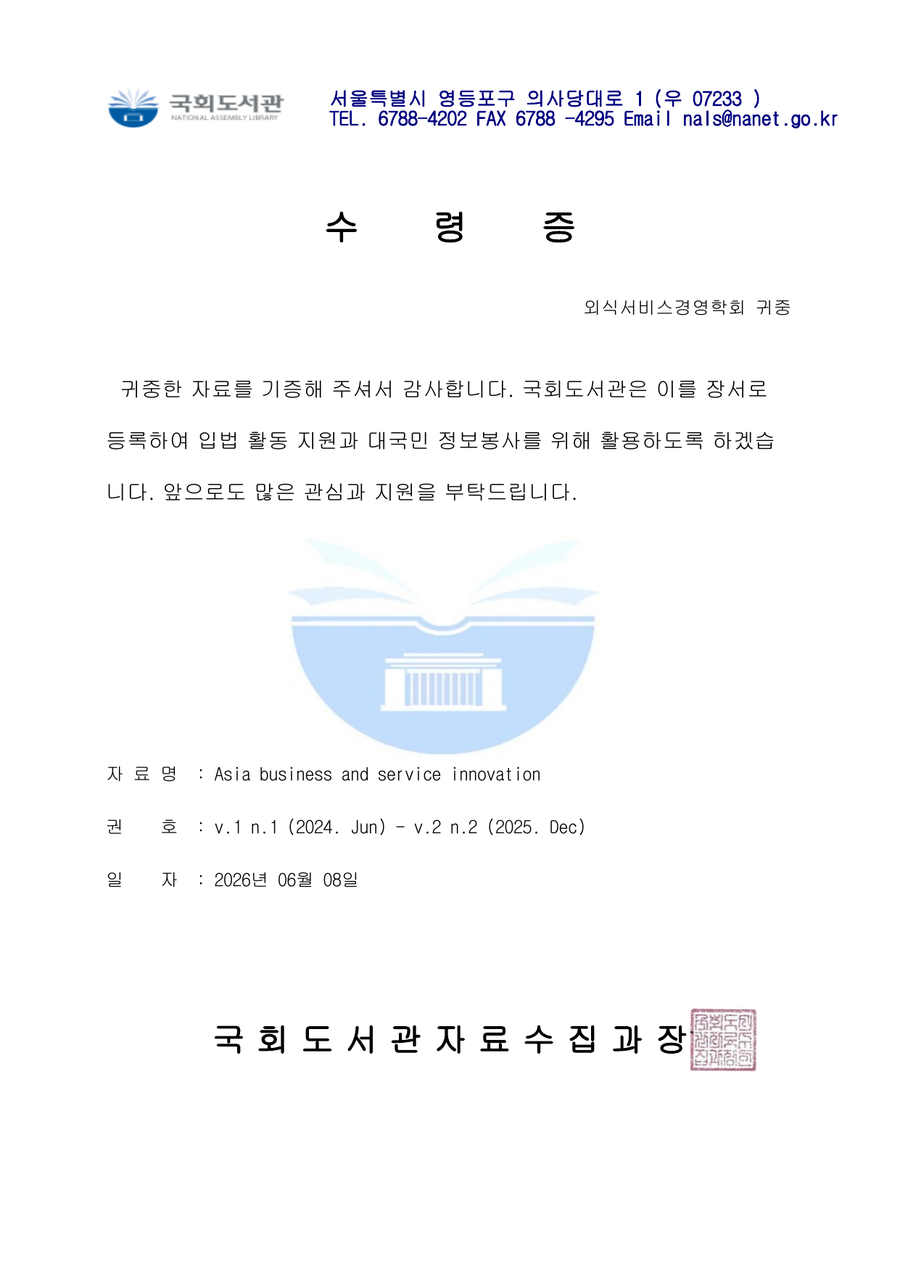
Acquisition receipt, National Assembly Library of Korea
All published content of Asia Business and Service Innovation is deposited with the National Library of Korea (NLK) for long-term preservation. The National Library of Korea is the official national legal deposit institution of the Republic of Korea, ensuring permanent preservation and accessibility of the journal's content as part of the national documentary heritage.
In addition, the complete run of the journal (Vol.1 Issue 1, June 2024 through Vol.2 Issue 2, December 2025) has been deposited and registered in the collection of the National Assembly Library of Korea (NANET) (registered June 8, 2026). This provides a second institutional repository for the journal, further strengthening long-term archiving and public access.
In addition, the journal maintains its own backup of all article files and metadata, ensuring redundant preservation of the published record.
Copyright Policy Registration
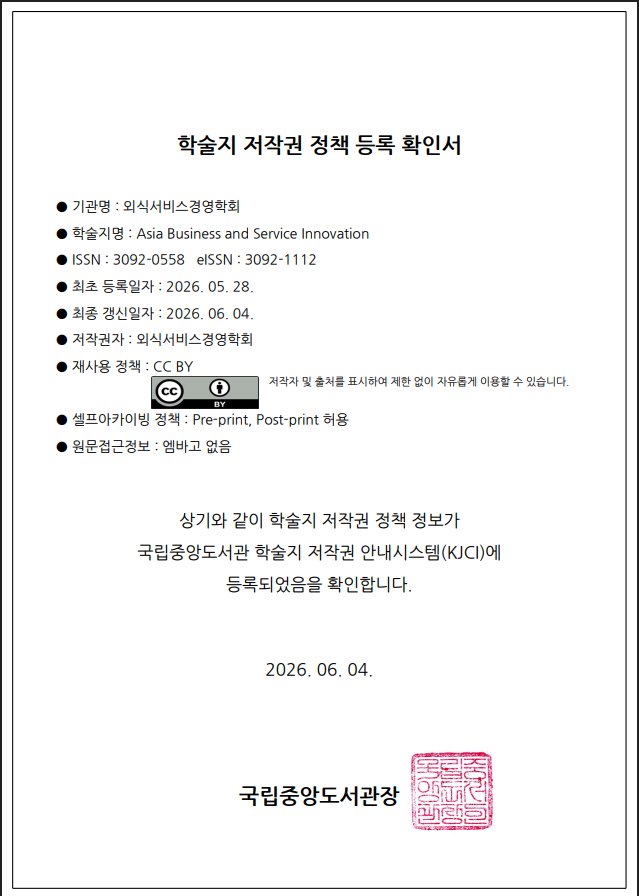
Registration certificate, National Library of Korea (KJCI)
The copyright and reuse policy of Asia Business and Service Innovation is officially registered with the Korea Journal Copyright Information System (KJCI), operated by the National Library of Korea. This registration provides independent, public confirmation of the journal's licensing and self-archiving terms.
The registered policy confirms the following:
- Reuse policy: Creative Commons Attribution (CC BY). Anyone may freely use the work provided the author and source are credited.
- Self-archiving: Both pre-print and post-print versions are permitted.
- Full-text access: No embargo.
- First registered: May 28, 2026
- Last updated: June 4, 2026
The official registration certificate issued by the National Library of Korea is shown below.
Privacy
Personal information collected through the editorial process (names, affiliations, contact details) is used solely for the purposes of editorial communication and is not shared with third parties without consent.
Research Ethics Committee
ABSI is published by the Academic Society of Food and Service Management, which maintains a standing Research Ethics Committee to verify compliance with the society's research ethics regulations and to investigate alleged research misconduct.
Purpose
The Research Ethics Committee examines suspected violations of research ethics and verifies the integrity of research published in the journal, on the basis of the society's research ethics regulations.
Composition
The committee is constituted by office, so that its membership does not depend on changes in individual officeholders:
- Chair: the Secretary General of the society (ex officio)
- Ex officio members: the President and the Editor-in-Chief
- Members: appointed by the Chair, up to six members including the Chair
- Secretary: one member elected from among the committee
The terms of the Chair, members, and secretary run concurrently with the term of the President and are renewable.
Authority and Proceedings
The committee is authorized to receive reports of alleged research misconduct and to conduct investigations to verify research integrity. After a broad investigation drawing on complainants, respondents, witnesses, and documentary evidence, where a violation is confirmed the committee may impose sanctions in accordance with the society's bylaws.
A meeting is convened and chaired by the Chair. Resolutions require the attendance of a majority of members and the affirmative vote of a majority of those present; a request for disciplinary action arising from confirmed misconduct requires the affirmative vote of two-thirds of those present. Committee members must maintain confidentiality regarding all matters under deliberation. Both complainants and respondents are guaranteed equal opportunity to present their views and to respond.
Sanctions
Where misconduct such as plagiarism or duplicate publication is confirmed, the committee may impose one or more of the following: expulsion from membership, suspension of membership, removal of the article from the journal, a ban on submission for a defined period, and notice on the society's website. Where an investigation finds no misconduct, the committee takes appropriate steps to restore the reputation of the respondent.
The full Research Ethics Regulations are maintained by the publishing society and are available at society.absi.kr/ethics.
Policy History
- Updated: June 8, 2026, complete journal run deposited and registered in the National Assembly Library of Korea (NANET)
- Updated: June 4, 2026, copyright policy registered with the Korea Journal Copyright Information System (KJCI), National Library of Korea
- Revised: May 28, 2026, fourth revision, clarifying copyright policy (copyright transferred to the publishing Society, which applies CC BY 4.0 to all articles)
- Revised: May 23, 2026, third revision, adding Long-term Preservation policy (National Library of Korea deposit)
- Revised: May 23, 2026, second revision, adding KCI Similarity Check policy with similarity threshold (recommended below 10%, maximum acceptable below 15%)
- Revised: December 30, 2025, first revision, adding policies on use of AI tools, open access and copyright, and self-archiving
- First adopted: June 2024 (inaugural issue)